School Core Values Examples and Motto Ideas

On this page
School core values examples include respect, responsibility, curiosity, integrity, empathy, and service. Choose words your community can define through everyday actions, then write a short motto that expresses your shared identity. For banners, select one clear trait or phrase per banner and keep the detailed explanation in lessons and school communications.
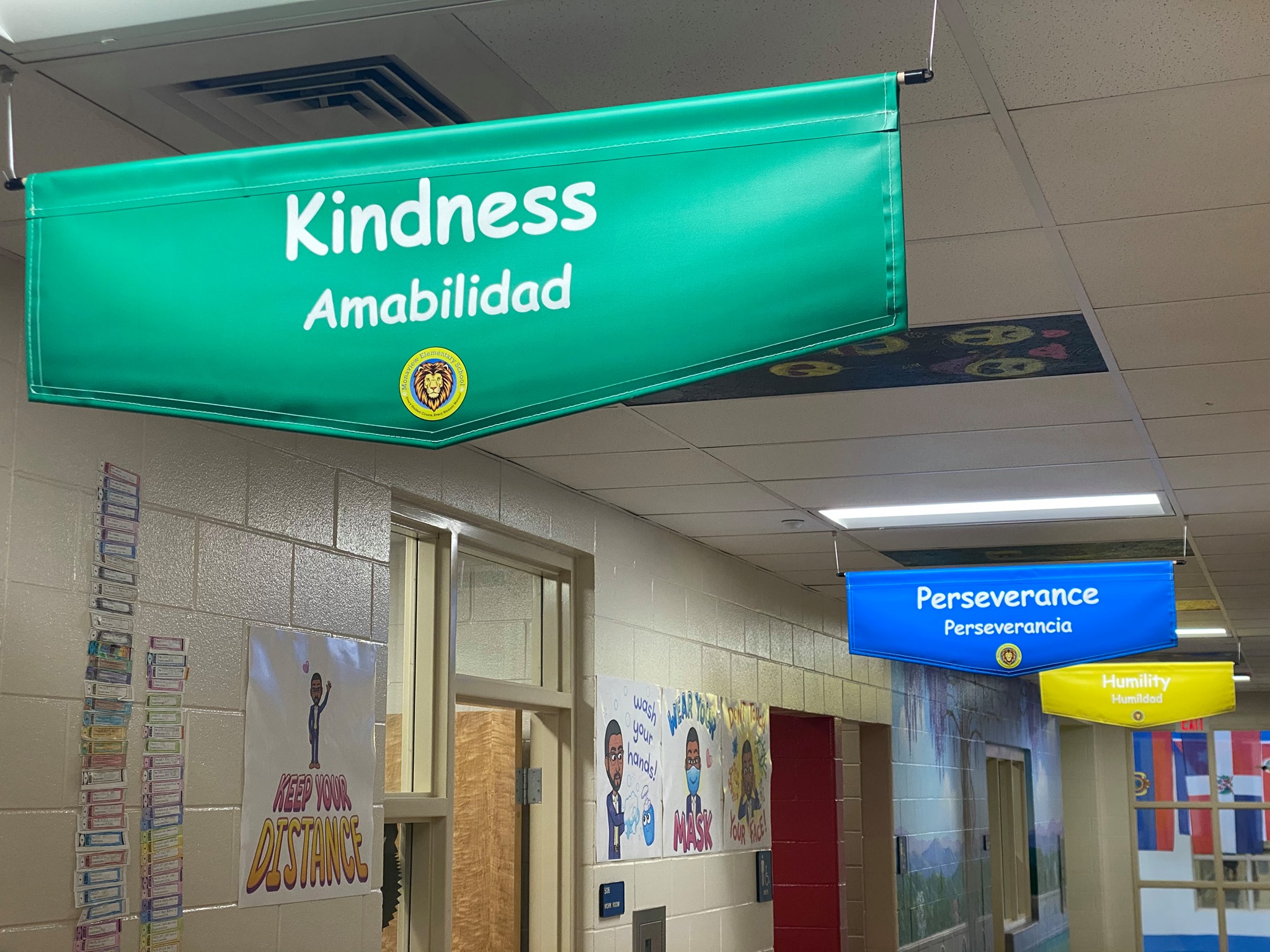
Prosign’s custom character education banners let schools display that language in their own colors, with an optional school logo. Start with the message your students and staff will actually use.
What is the difference between school values, a values statement, and a motto?
Each serves a different purpose. Child Trends’ guide to vision, mission, values, and goals describes values as principles that guide decisions and how people are treated. A motto gives your community a short expression of that identity.
| Type of wording | Purpose | Illustrative example |
|---|---|---|
| Core value | Names a guiding principle | Curiosity |
| School values statement | Explains a shared commitment | We ask questions and explore ideas with care. |
| School motto | Expresses a shared identity concisely | Curious Minds. Caring Choices. |
| Banner message | Gives one value or phrase visual emphasis | Explore with Care |
A mission statement explains the school’s purpose; it usually needs more room than a banner provides. Keep the full statement on your website or in a handbook. For broader program planning, see our complete guide to character education.
Which school core values examples fit each age group?
A school can keep shared values while changing the examples students encounter. Horace Mann School’s core-values page explicitly describes interpreting values across developmental stages. Use your students’ language and experiences to make that translation locally.
The examples and motto options below are original starting points for your team to adapt.
Elementary school: make the action easy to picture
For younger students, pair a value with a familiar action. Adults can introduce the bigger word while using a short phrase as a reminder.
| Value | What it could look like | Possible banner wording |
|---|---|---|
| Kindness | Invite someone to join a partner activity. | Make Room for a Friend |
| Responsibility | Return shared supplies after using them. | Care for What We Share |
| Curiosity | Ask a question about something unfamiliar. | Bring Your Questions |
| Honesty | Explain what happened and ask for help fixing it. | Tell the Truth. Find a Fix. |
Elementary school motto ideas:
- Small Questions. Kind Choices. Shared Discoveries.
- We Notice. We Help. We Learn.
Ask students to explain each option with a drawing, a story, or their own words. A phrase that adults admire may still need revision if children cannot connect it to an action.
Middle school: connect values to voice and relationships
Invite students to test the tone. Ask which wording sounds natural, which sounds patronizing, and which they would feel comfortable discussing with classmates.
| Value | What it could look like | Possible banner wording |
|---|---|---|
| Respect | Summarize a classmate’s idea before disagreeing. | Hear the Idea First |
| Belonging | Invite a peer’s contribution during group work. | Make Room for Another Voice |
| Accountability | Acknowledge a missed commitment and plan a repair. | Own Your Next Choice |
| Perseverance | Try another strategy and request useful feedback. | Rethink. Ask. Try Again. |
Middle school motto ideas:
- Our Ideas Matter. Our Choices Count.
- Try Thoughtfully. Speak Fairly. Build Together.
Our article on building a culture of kindness in middle school offers related discussion and activity ideas. Here, the immediate task is choosing language students can explain and use.
High school: emphasize judgment, integrity, and contribution
Use examples that invite students to make decisions, consider evidence, and contribute to their community.
| Value | What it could look like | Possible banner wording |
|---|---|---|
| Integrity | Credit the sources and collaborators behind a project. | Honor the Work Behind Yours |
| Critical thinking | Check evidence before sharing a claim. | Question with Care |
| Service | Ask a community partner what help would be useful. | Contribute Where It Matters |
| Leadership | Seek feedback before making a group decision. | Lead by Inviting Input |
High school motto ideas:
- Think with Purpose. Contribute with Care.
- Questions Welcome. Responsibility Shared.
For service-related examples beyond a slogan, explore our citizenship education activities.
How do you choose school core values with your community?
Begin with listening. CASEL’s shared-vision guidance recommends structured input from staff, students, families, and community partners. The following process adapts that collaborative approach to values and motto wording.
- Gather specific stories. Ask, “When have you felt proud to belong here?” and “What should someone experience when they join our school?” Offer discussion and written response options; invite people who do not usually attend leadership meetings.
- Find recurring commitments. Group similar ideas. Compare them with existing district commitments and school traditions before proposing new words. Avoid selecting values solely to complete a mascot acronym.
- Define each candidate in action. Write one student example and one adult example. If respect means hearing students out, describe how staff will model that commitment too.
- Test a small shortlist. Ask students across grades, families, and staff to paraphrase the wording. Invite feedback in the languages your community uses. Ask what feels unclear or missing, not just which option wins a vote.
- Approve and share the reasoning. Record the final spelling, capitalization, definitions, motto, and approver. Explain how feedback shaped the decision, then use the agreed language consistently.
As a practical starting point, consider three to five priorities your team can teach and revisit. Existing district values may already provide the right set. Once the wording is agreed, our character trait of the month calendar can help you plan activities and announcements.
How do abstract values become clear banner messages?
Use this sequence: value → shared meaning → observable action → short display wording.
For example, a team might begin with “excellence,” define it as improving work through feedback, describe students revising a draft after a conference, and choose Make Your Next Draft Stronger as the banner phrase. The lesson explains the value; the banner recalls the shared language. For a setting-by-setting teaching framework, explore our PBIS expectations examples and schoolwide matrix.
Character.org’s 2026 self-assessment connects behavioral definitions, staff modeling, visible reminders, and student practice. Banners can support that work as prompts within a taught program.
If your school already teaches a familiar term such as Integrity, keeping that single word may be clearer than inventing a new slogan. Prosign accommodates one trait or phrase per banner. See character banners in school settings to compare how short messages and school identity work together.
What should you check before approving banner wording?
Use this checklist for character education banner sayings and motto phrases:
- One main message: Give each banner one trait or phrase. Move definitions and activity directions into teaching materials.
- Plain language: Replace committee jargon with words students can explain. Teach unfamiliar value words explicitly.
- Observable meaning: Have an example ready for “What would that look like today?” Include an adult example.
- Inclusive wording: Check that students can participate in different ways. Avoid making eye contact, speaking aloud, or working without help the sole sign of a value.
- A readable design: Review text/background contrast, font weight, spacing, and line breaks. Check the phrase from its intended viewing position using an appropriately scaled mock-up when practical.
- Clear visual priority: Keep the value or phrase prominent when adding a school name or logo. Shorten crowded wording before asking for smaller type.
- Exact proof copy: Confirm spelling, punctuation, capitalization, colors, logo version, and the text on every banner in the set.
Use Prosign’s banner color and font options to prepare your design choices. Review the actual typeface, weight, sizing, and layout in the design proof; screen colors are a guide and may differ from printed vinyl.
How do you move from approved wording to custom banners?
Prepare a list with the exact text for each banner, your school colors, font preference, optional logo, and the person responsible for proof approval. Keep the full values definitions available for staff who will introduce the messages.
Review character banner options and current pricing. Standard pricing is per banner, and shipping and handling are additional. Then start a custom banner request with your approved wording and design choices. Review the proof before production.
When introducing the banners, connect each message to an example students have discussed or practiced. Ask them to explain the connection in their own words and revisit phrases that remain unclear.
Frequently asked questions
What are good school core values?
Respect, responsibility, empathy, honesty, curiosity, integrity, and service are useful candidates. Choose a set that reflects your school’s commitments and can be explained through student and adult actions.
What makes a good school motto?
A useful motto expresses a shared identity in language the community understands. Test whether students can explain it, whether staff can model it, and whether it fits the values you have selected.
Should elementary, middle, and high schools use different values?
They can share values while adapting the examples and wording. An elementary explanation of responsibility may involve shared supplies; a high school example may involve meeting commitments in a collaborative project.
Can our mascot become an acronym for our values?
Yes, if each word fits your school’s commitments. Choose the values first, then test the acronym. Keep plain-language definitions available so students do not have to decode the letters.
Can we put our own school motto on a character banner?
Prosign offers custom wording with one trait or phrase per banner, school colors, and an optional school logo. Submit your proposed phrase and review its fit and legibility in the proof.
Turn your shared values into a message students recognize
Choose the words, define the actions, and approve a clear message for each banner. Prosign can carry that language into a coordinated design for your school. Start your custom character education banner order with your chosen traits or motto phrases, colors, and optional logo, then review the design proof before production.
Key Takeaways
- Choose shared values with students, staff, and families, then define them through everyday actions.
- Adapt examples and motto wording to students’ ages while keeping the school’s commitments consistent.
- Give each banner one clear trait or phrase and review exact wording and readability in the proof.